Renovation projects come with enough unknowns and are inherently complex. The idea of renovating an existing building can be exciting, but it comes with many underlying challenges. Inaccurate drawings, missing drawings or undocumented modifications, and hidden structures or MEP elements can make it difficult for engineers, architects, and contractors to understand a building’s condition.
This is where scan-to-BIM services play a significant role. It transforms real-world building data into an accurate digital model, helping owners to plan renovations by minimizing costly surprises.
Here’s a practical guide for owners of scan-to-BIM services for renovations.
Why do renovation projects fail?
Renovation projects fail because of the core issue of uncertain existing conditions. When the building was built, it was made with traditional methods, such as reliance on legacy CAD drawings or manual site measurements. The manual measurements are time-consuming and prone to human errors. As there was no further data, the design team had to work with assumptions instead of verified data. Moreover, the as-built drawings rarely reflect the current site reality. These gaps can be discovered too late, once the renovation project is completed, and can lead to costly changes and compromised design intent.
To overcome these challenges, it is a wise business move to collaborate with a leading BIM company in USA that provides advanced Scan to BIM and point cloud services, ensuring accurate renovation planning.
What is Scan to BIM?
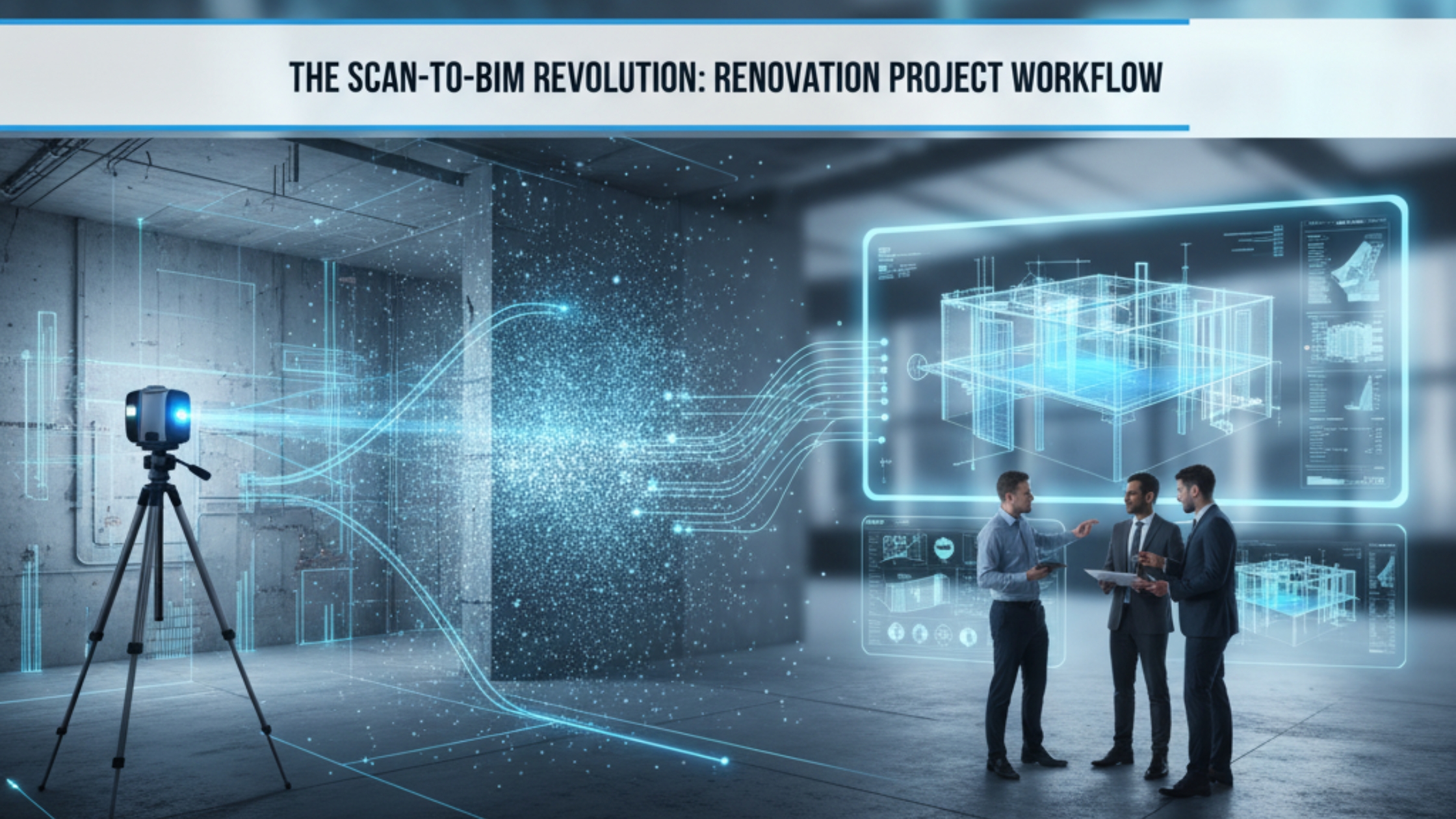
Scan to BIM is the process of using 3D laser scanners to capture accurate, as-built spatial data of physical structures and to convert the resulting point cloud data into a 3D parametric BIM model. This data becomes a single source of truth for renovations that can be used by engineers, architects, contractors and the facility team throughout the renovation lifecycle.
How Scan to BIM Adds Value in Renovation Projects
Scan-to-BIM services offer many practical advantages, especially when combined with point cloud-to-BIM services that transform scan data into usable models:
- Reduced design risk: The design team works on verified data and reality, not on assumptions. This lowers the risk of design conflicts between the structure, architecture, and MEP systems.
- Precise representation of actual conditions: Scan-to-BIM services reflect the actual dimensions, penetrations, system layouts, etc., of the owners, and they remove the guesswork.
- Enhanced collaboration: Scan to BIM acts as a single source of truth that all consultants refer to. This improves the collaboration and reduces the misalignment between disciplines.
- Long-term asset value: The BIM model generated from the cloud can be used for further renovations, facility management, and maintenance planning.
Conclusion
Scan to BIM is a strategic investment in efficiency, accuracy, and long-term asset value. The master key to successful renovation projects is to partner with BIMPRO LLC, a leading BIM company in the USA that specializes in delivering advanced Scan to BIM solutions for renovation and retrofit projects. Their skilled team works to improve project efficiency, teamwork, and accuracy by using advanced BIM technologies. They confirm that each project is delivered on time and within budget.
 :
https://www.pinterest.com/bimprollc/
:
https://www.pinterest.com/bimprollc/