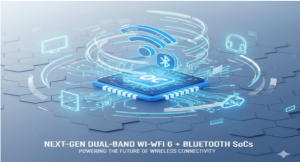
Next-Gen Dual-Band Wi-Fi 6 + Bluetooth SoCs
The need to have high-speed, stable, and energy-efficient wireless connectivity has never been bigger. As smart homes grow, entertainment devices gain strength and IoT ecosystems gain momentum at an unprecedented rate, manufacturers need an effective connectivity solution that provides dense environments with consistent performance. This critical gap is filled with modern Dual-Band Wi-Fi 6 + Bluetooth SoCs, and a small and highly optimized platform is created around streaming, gaming, automation, AR/VR, and next-generation smart devices.
These are not mere upgrades of the previous SoCs, but an architectural change. Rather than viewing Wi-Fi and Bluetooth as two different systems, both technologies are currently synchronised to work together as one smart system, and work together at the same time without interruption. Such integration leads to better performance at a low cost, simplification of board design, and reduction in overall system power consumption.
Growing Demand for Advanced Wireless Performance
The devices in the world today operate in a high density of dozens of overlapping Wi-Fi networks, Bluetooth accessories, and users expect high quality and continuous streaming. Smart television transmits 4K or 8K data, tablets are used to work with online education and entertainment, game consoles are based on low-latency wireless connections, and IoT enables devices to interact with mobile applications and clouds.
Under these circumstances, older wireless standards are not in a position to keep up. Wi-Fi 6, however, is created to address the situation of high density. Such characteristics as OFDMA, MU-MIMO, 1024-QAM modulation, and BSS Coloring keep the network under efficient sharing by the various devices without delays and collisions. With dual-band support, the devices can smoothly allocate workload within the 2.4 GHz to 5 GHz, gaining a balance between speed, coverage, and interference management.
The development of Bluetooth has also seen BLE Audio and Bluetooth 5.2/5.3, based on lower latency, audio quality, and power efficiency. In the case of gadgets like headphones, speakers, wearables, and controllers, it is a significant improvement.
These technologies combined are solutions to wireless needs of the contemporary world to include seamless streaming, consistent peripheral connections, and continuous connectivity even in the most crowded areas.
The Architecture Behind Modern Wi-Fi 6 + Bluetooth SoCs
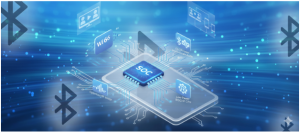
The Architecture Behind Modern Wi-Fi 6 + Bluetooth SoCs
The fundamental components within these sophisticated platforms of wireless are the combination of optimized RF design with silicon-proven connectivity IP and low-power RISC-V CPU subsystem. It is an integrated architecture that guarantees expeditious processing, low power consumption, and wireless communication security.
Wi-Fi 6 can be improved to enable much higher throughput and lower latency. In practice, the users can feel such benefits as faster downloads, high-quality UHD streaming, more stable videoconferencing, and improved performance in multi-user mode.
Integration of Bluetooth increases the compatibility of devices and the streaming of audio. The SoC also supports the LC3 codec and multi-stream audio, which ensures that it offers quality audio and reliable wireless connections to accessories.
RISC-V CPU has scheduling, MAC control, power modes, and system-level wireless. It has lower power consumption than other energy-efficient models without compromising real-time performance, as it can be customized.
This combination renders these SoCs powerful and efficient, and applicable in consumer devices as well in industrial devices.
Energy Efficiency and Power Optimization
With the devices becoming smaller and increasingly compact and battery-operated in the form of portable devices, power consumption has become a definite parameter. Wi-Fi 6 has the Target Wake Time (TWT) feature that allows gadgets to go into deep sleep modes and only wake up when it is time to communicate. This drastically saves on power wastage.
Transistors with low leakage, customized RF, and smart power gating reduce consumption even more at the silicon level. This is complemented by ultra-low-energy protocols of Bluetooth, which are efficient in streaming and in providing long-range connectivity to the peripherals.
The outcome is a platform that retains high wireless capabilities and increases battery lifespan in tablets, smart speakers, wearables, and IoT devices, which are important to products that are supposed to run throughout the day.
Real-World Applications and User Impact
This is the new generation of connectivity SoCs that improve the performance of a broad device portfolio. The Smart televisions and set-top boxes enjoy the benefits of a constant high-speed connection that does not buffer even during peak time. Gaming systems have reduced latency and performance. Tablets and mobile devices are also more responsive to the network and have better energy efficiency.
The smart devices of a home, be it a light, sensor, camera, or appliance, are more likely to have an increased range, reliability, and stability of a network. The reduction of latency and optimal dual-band connectivity are big advantages to AR/VR systems in terms of engaging the user with the environment and the possibility of real-time interaction.
Such upgrades are not only technical; they bring more direct benefits to users. Quick loading experience, better audio, continuous streaming, and better interaction between devices make the connected life more seamless.
Reduced Complexity for Manufacturers
Among the greatest benefits of Dual-Band Wi-Fi 6 + Bluetooth SoCs is the decrease in the complexity of the system. Manufacturers will be able to use a highly integrated SoC instead of having to combine more than one wireless module with a set of independent antennas, filters, and interfaces.
This leads to:
• Lower BOM cost
• Simplified PCB layouts
• Reduced RF design challenges
• Faster certification
• More consistent mass-production performance
In the case of consumer electronics manufacturers, these benefits reduce the time of development, and enhance the reliability of products.
Security and Long-Term Reliability
All related systems have security as an issue of concern. The latest Wi-Fi 6 + Bluetooth SoCs have hardware-based security functions like secure boot, advanced encryption, and WPA3. This provides security to those devices that use either public networks, home networks, or enterprise setups.
Moreover, they have a silicon-proven architecture that guarantees long-term stability of their performance, hence can be deployed in large-scale applications where reliability is paramount.
A Future-Ready Connectivity Platform
Future solutions will be based on scalable and flexible connectivity solutions as the wireless industry approaches Wi-Fi 7, Matter-based IoT ecosystems, and a more powerful BLE Audio. That is offered by dual-band Wi-Fi 6 + Bluetooth SoCs.
Wi-Fi 7 will be faster and have reduced latency, while improvements to Bluetooth will enable streaming audio and multi-device audio capabilities. With the transition to multi-protocol IoT and the adoption of common standards for smart homes, the coexistence of wireless technologies will become even more essential.
These new SoCs lie in the middle of this evolution. They provide the performance, efficiency, and flexibility needed to drive next-generation consumer electronics, enterprise systems, industrial devices, and smart home devices.
Conclusion
Wi-Fi 6 + Bluetooth SoCs are a significant breakthrough in history. Their high throughput, stable coexistence, low power, and small integration make them invaluable in the modern and future smart ecosystem. These SoCs can be utilized to serve a wide range of purposes in entertainment systems, wearables, smart homes, industrial IoT, or immersive devices, to provide the strong wireless base needed to support the latest digital experience.
With the world progressing towards more interconnected ways of life, these SoCs are already defining the next generation of performance- quicker, more secure, energy, and more so than ever before.
 :
https://in.pinterest.com/t2msemi2018/
:
https://in.pinterest.com/t2msemi2018/