Modern development teams merge hundreds of changes into shared repositories every week. Without clear standards, code reviews can become inconsistent, subjective, or rushed. This is where quality gates play a crucial role. By defining measurable criteria that every merge request must satisfy before integration, quality gates bring structure, discipline, and accountability to the review process.
Rather than relying solely on human judgment, teams can enforce objective checks that protect code quality, maintainability, and long-term system stability.
What Are Quality Gates in the Context of Code Reviews?
Quality gates are predefined conditions that code must meet before it can move to the next stage of the development lifecycle. In code review workflows, they typically operate within version control platforms and CI pipelines.
These gates may include:
- Minimum test coverage thresholds
- Static code analysis results
- Linting and formatting standards
- Security vulnerability scans
- Performance benchmark checks
- Build and deployment validation
When a merge request fails any of these criteria, it cannot be approved or merged. This shifts the review process from opinion-driven discussions to data-backed decisions.
The Problem with Unstructured Code Reviews
Without quality gates, code review discipline often deteriorates over time:
- Reviewers focus only on logic and overlook security or performance risks
- Test coverage becomes inconsistent
- Minor formatting issues consume review time
- Merge pressure leads to approvals without thorough validation
- Standards vary between reviewers
Over time, this inconsistency increases technical debt and reduces confidence in releases. Quality gates introduce consistency and enforce shared engineering standards across teams.
How Quality Gates Strengthen Merge Request Discipline
1. Enforcing Objective Standards
Quality gates define what “ready to merge” truly means. Instead of debating whether a change is acceptable, reviewers can rely on measurable benchmarks.
For example:
Code must pass all automated tests
Coverage must not drop below an agreed threshold
No high-severity vulnerabilities may exist
This removes ambiguity and ensures uniform expectations across contributors.
2. Reducing Reviewer Fatigue
Reviewers often spend time identifying formatting issues, simple syntax mistakes, or obvious test failures. Automated quality gates eliminate this overhead by catching these issues before human review begins.
As a result, reviewers can focus on:
Architectural decisions
Edge case handling
Business logic accuracy
Long-term maintainability
This makes the review process more efficient and meaningful.
3. Encouraging Developers to Self-Validate
When quality gates are integrated into pipelines, developers know their code must pass automated checks before it reaches reviewers. This promotes a culture of accountability and preparation.
Developers:
Run tests locally before submitting
Address static analysis warnings early
Ensure coverage requirements are met
Validate edge cases more thoroughly
This proactive mindset reduces rework and shortens review cycles.
4. Standardizing Quality Across Teams
In distributed or fast-growing teams, maintaining consistent review standards is challenging. Quality gates act as a shared rulebook that applies equally to everyone.
Whether a change comes from a senior engineer or a new contributor, it must satisfy the same criteria. This fairness improves trust in the process and reduces friction during reviews.
Integrating Quality Gates with CI/CD Workflows
Modern CI/CD systems make it easier to embed quality gates directly into merge pipelines. Typical integrations include:
- Automated unit and integration test execution
- Static code analysis tools
- Security scanners
- Coverage reporting tools
- Code complexity analysis
When combined, these automated validations ensure that every merge request meets predefined engineering standards before being deployed or released.
By grounding merge discipline in automation, teams reinforce the importance of strong engineering foundations, including adherence to software testing basics such as structured test cases, coverage tracking, and validation of critical workflows.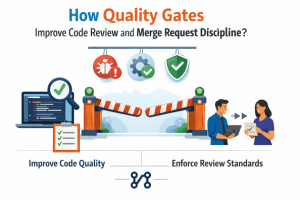
Impact on Code Quality and Technical Debt
Over time, disciplined merge processes significantly influence long-term system health.
Lower Defect Introduction Rate
Since every merge must pass functional, structural, and security checks, fewer defects slip into main branches. This reduces the need for emergency patches and production hotfixes.
Improved Maintainability
Quality gates often include checks for complexity and duplication. Preventing overly complex code from entering the system keeps the codebase readable and easier to modify.
Sustainable Growth
As the codebase expands, the cost of inconsistent standards grows exponentially. Quality gates ensure that growth remains controlled and maintainable rather than chaotic.
Balancing Strictness and Developer Velocity
While quality gates improve discipline, overly rigid criteria can slow development. Teams must strike a balance between enforcement and agility.
Best practices include:
- Setting realistic coverage thresholds
- Gradually increasing standards over time
- Differentiating between critical and non-critical failures
- Monitoring build times to prevent pipeline delays
- Reviewing gate effectiveness periodically
The goal is not to block progress but to guide it in a structured and sustainable way.
Cultural Benefits Beyond Automation
Quality gates do more than enforce technical checks. They influence team culture.
Promote accountability
Reduce subjective conflicts in reviews
Create transparency around quality expectations
Encourage continuous improvement
When merge discipline becomes data-driven, teams spend less time debating opinions and more time improving design and architecture.
Measuring the Success of Quality Gates
To evaluate effectiveness, teams can track:
- Merge request rejection rates
- Review cycle time
- Post-release defect rates
- Code coverage trends
- Security incident frequency
If quality gates are working correctly, review time becomes more focused, defects decrease, and release confidence improves.
Conclusion
Quality gates transform code review from a manual checkpoint into a structured quality assurance mechanism. By enforcing objective standards before merge approval, they reduce ambiguity, improve reviewer efficiency, and promote developer accountability.
In fast-paced development environments, disciplined merge request workflows are essential for maintaining system stability. When thoughtfully designed and integrated into CI pipelines, quality gates become a foundation for consistent, scalable, and high-confidence software delivery.
Strong review discipline is not about slowing teams down. It is about ensuring that every merged change strengthens the system rather than weakening it.
 :
https://in.pinterest.com/
:
https://in.pinterest.com/