Industrial advancement continues to be dependent on mechanical engineering. Since the era of heavy manufacturing systems, high-tech offshore, and automation systems, almost all major industries rely on powerful mechanical design and analysis. However, in the modern world of the quickly changing market, only traditional drafting and simple engineering assistance are not sufficient. To remain competitive, companies need simulation-based insights, optimal product development plans and scalable engineering skills.
Advanced mechanical engineering solutions integrate innovation, model precision, performance validation, and lifecycle support – get ideas to production easily. In this blog, we explore how advanced mechanical engineering services empower industries to reduce risk, improve product performance, and accelerate time to market.
The Evolution of Mechanical Engineering in the Digital Era
The field of mechanical engineering has seen an enormous change in the past twenty years. Previously, the product development aspect depended on manual drafting, physical models, and test and error. Though effective then, the processes were sluggish, expensive, and had a tendency to fail in design at late stages.
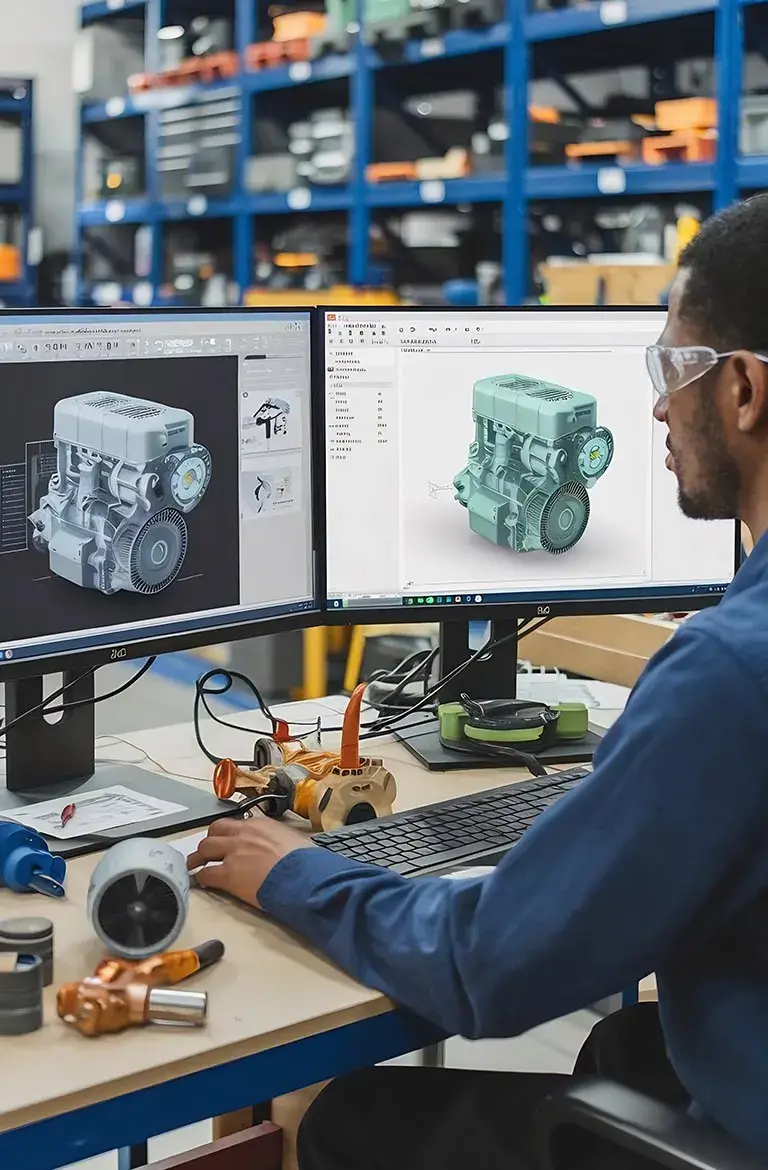
Digital engineering tools nowadays have changed how products are designed. High-end CAD systems enable very accurate 3D modeling, and performance can be assessed using simulation tools like Finite Element Analysis (FEA) and Computational Fluid Dynamics (CFD) that are engineered to be used even before physical manufacturing has even started.
This online revolution brings with it a number of important benefits:
- Reduced prototyping costs
- Faster design iterations
- Timely identification of structural or thermal problems.
- Greater adherence to safety standards.
- Increased product reliability.
Engineering has ceased to be reactive, it is predictive. And predictive engineering is a dramatic way of improving results.
From Concept to Creation: The Importance of Structured Product Development
Any successful mechanical system starts with a well organized development process. Without a clear requirement, making a jump right to modelling will usually lead to costly redesign in the future.
A strategic engineering process normally encompasses:
- Requirements definition: Identification of functional requirements, environmental requirements, load requirements and standards of compliance.
- Concept Development: Assessing different design methods based on cost effectiveness and feasibility.
- Detailed CAD Modelling: Parametric CAD 3D models and technical drawings.
- Simulation & Validation: Checking the stress limits, fatigue life and thermal performance.
- Preparation of Manufacturing: Making sure design is made to be fabricated and put together.
Such a formalized workflow minimizes the uncertainty and makes sure that the mechanical systems work as intended in reality.
Simulation-Driven Engineering: Reducing Risk Before Production
Simulation-driven validation is one of the most effective works in modern mechanical engineering. Instead of finding out the design defects after production, now engineers can have an opportunity to find out what may go wrong virtually.
Why Simulation Matters
The work of mechanical systems is under complicated forces – stress, vibration, changes of temperature, fatigue, loads of environment. These factors can be reviewed accurately using simulation tools.
Key benefits include:
- Determining stress concentration points.
- It predicts under loading deformation.
- Evaluation of the material performance.
- Assessment of the behavior of fluid flow.
- Extreme environmental simulation.
Companies save a lot of time and resources since they solve problems digitally. Simulation does not substitute engineering knowledge, it supplements it by giving it data-based clarity.
Precision Through Advanced Modelling and Drafting
The most brilliant idea cannot work without accurate implementation. The modelling and drafting are of high quality, which means that the ideas are converted into manufacturable and correct components.
Modern CAD systems allow:
- Parametric 3D modelling
- Assembly simulations
- Tolerance verification
- Expansive drawings of fabrication.
- Purchasing of materials.
Precise documentation facilitates smooth interaction between the design, procurement and production departments. It also minimizes the miscommunication, as well as, it lowers costly manufacturing errors.
Even the slightest mistake in drafting in a large-scale industrial project can contribute to substantial downtimes or safety issues. That is why precision modelling is an essential part of professional mechanical engineering.
Revitalizing Legacy Systems with Reverse Engineering
Most industrial firms use machines that were constructed centuries back. Regrettably, the documentation can be incomplete, out-of-date and even absent. The solution to this challenge is through reverse engineering.
With advanced scanning, measurement and CAD reconstruction, the engineers are able to:
- Recreate obsolete parts
- Modernize legacy machinery
- Improve outdated designs
- Provide digital storage of important information.
Reverse engineering does not only maintain the continuity in operations but also introduces the possibility of optimization and improvement of performance.
Such a strategy is especially useful in factories, shipyards, and heavy industries where it is impractical or even prohibitively expensive to replace a whole system.
Mechanical Engineering in Heavy and Offshore Industries
Critical engineering works, like the marine constructions, offshore platforms, and industrial structures, require high-quality accuracy and stability. These conditions display equipments to extreme loads, corrosion, vibration, and temperature fluctuations.
In these industries engineering assistance may encompass:
- Structural load analysis
- Fatigue life assessment
- Selection of materials in harsh environment.
- Adherence to safety standards.
- Durability planning in long-term.
Mishaps that are happening in heavy industries are not only expensive but also unsafe. High-tech analysis guarantees the level of safety and longevity.
Value Engineering: Improving Performance While Reducing Costs
Making things smarter, more efficient, is not just the job of mechanical engineering to make things stronger.
Value engineering is a design-based approach that aims at minimizing the design to lower material consumption, ease the production process, and minimise the total lifecycle costs without affecting the performance.
This can involve:
- Alternative material choice.
- Eliminating the excess weight.
- Efficiencies in part assembly.
- Reduction of the complexity of machining.
- Enhancing Energy efficiency.
Innovation that is cost-effective is a common factor that defines leadership in competitive industries.
Bridging Design and Manufacturing
A sound design should also be fabricable. Most of these projects do not fail because the design is faulty, but the fact that production was not taken into account.
Engineering-based manufacturing support guarantees:
- Fabrication feasibility
- Assembly efficiency
- Supply chain compatibility
- Integration of quality control.
- Production scalability
This way of integrating engineering and manufacturing early on helps companies to eliminate the expensive redesigns as the products are being made.
Flexible Engineering Support for Growing Businesses
The companies may need to hire more engineering staff on a temporary basis as the projects increase in size. Scalable engineering alliances offer flexible knowledge that can be adjusted to the workload requirements.
By so doing, businesses are able to:
- Access specialized skills
- Handle peak project loads
- Accelerate timelines
- Maintain budget control
Engineering assistance is an extension of the internal team and not an external department.
Engineering Across the Entire Product Lifecycle
The production is not the end of mechanical systems. They need to be monitored, optimized, and even redesigned in their lifetime.
Full-time engineering assistance encompasses:
- Performance upgrades
- Retrofitting older systems
- Failure analysis
- Projects on continuous improvement.
- Documentation updates
A lifecycle approach can make sure that the mechanical systems are efficient and compliant enough years to come.
The Strategic Advantage of Expert Mechanical Solutions
In the modern world competitive environment, mechanical engineering has to strike a balance between accuracy, creativity, economy and speed. The competitive advantage which is brought about by investing in the advanced engineering solutions is clear in companies.
Dependable engineering assistance assists:
- Reduce operational risk
- Improve product durability
- Improve compliance with regulations.
- Speed up product introduction.
- Expand customer satisfaction.
As engineering is converted into a strategic approach as opposed to a reactive response, performance in organizations is tangible.
Seashore Solutions is a specialist in providing full-service mechanical engineering solutions that are in line with the modernist needs of the industry with a high level of precision engineering, innovation, and performance optimization. The team focuses on accuracy, efficiency and real-world manufacturability through advanced CAD modelling and simulation based analysis and structural validation and lifecycle support. SeaShore provides technical expertise and industry-specific understanding to the business to minimize design risks and increase system life cycle and speed up project implementation – taking mechanical ideas and creating reliable and production-ready solutions.
Final Thoughts: Engineering the Future with Confidence
Mechanical engineering has ceased to be an activity that takes place at drafting tables and workshop floors. It can be described as a knowledge-based field that is data-driven and simulation-driven, as well as defining the future of manufacturing, offshore development, automation, and heavy industry.
Companies that are adopting the best mechanical engineering practices lessen the risk, enhance innovative ability, and solidify their market stance. Professional engineering skills make it accurate at every step, be it modernization of old systems, creation of new machinery, or even structural performance validation.
In a world where trust and reliability are the keys to success, there is no other way of putting it, but to invest in extensive mechanical engineering solutions is a necessity.
 :
: